St Pius X Unanderra
A Catholic Parish Primary School
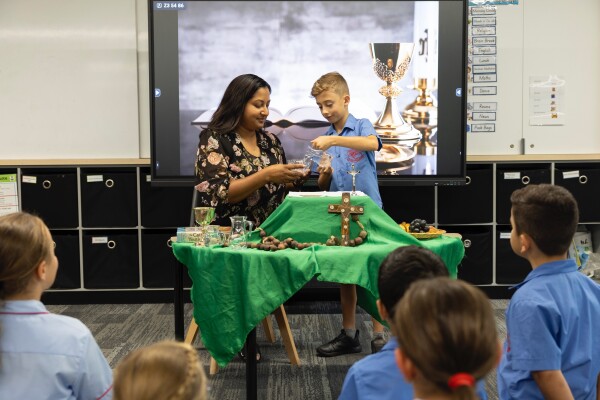
The formation of Christian values underpins all that we do at St Pius X Catholic Primary School, Unanderra, and students also experience formal Religious Education lessons each day based upon the K-12 Religious Education curriculum of the Diocese of Wollongong.
Religious Education (RE) is one of our Key Learning Areas. The RE curriculum is set by the Bishop of Wollongong in conjunction with Catholic Education Diocese of Wollongong.
The Emmaus Story (Luke 24:13-35) is central to the Religious Education curriculum. The curriculum is based on the four movements of the Emmaus story.
The Religious Education curriculum aims to assist students to reflect upon, make sense of, celebrate and live more deeply the mystery of Christ. Relationship with God is nurtured through catechesis, prayer and ritual enabling/supporting students to contribute positively to the community and culture. The content strands and themes of learning aim to lead students towards love of God, love for others and for all of creation as they become open to the presence and activity of God in their lives.
Explicitly for RE, the teaching and learning process should incorporate storytelling and creative arts, and foster the development of the four cognitive processes of Religious Literacy:
Catholic schools are called to be real and living expressions of the church’s pastoral mission in the world. As centres of ‘the New Evangelisation’ they proclaim and give witness to a living encounter with Christ. Catholic schools nurture students in their lifelong journey in faith and help them develop as mature educated citizens empowered to shape and enrich the world by living the Gospel of Jesus Christ in their everyday lives.
As an integral expression of Church, schools have the opportunity to support students and their families in connecting with the Catholic Christian tradition and accessing the richness of its spiritual heritage. Through quality Religious Education, rich experiences of prayer and celebration, engagement in social action and justice, students are supported in developing their relationship with God and responding to the experience and action of God in their own lives.
Religious Education is a lifelong process. Parents are the first and foremost educators of their children and the family is generally the first place where children come to Christian faith. Catholic Schools provide Religious Education to nourish and develop the faith of students in partnership with the family, parish and local community. Within the contemporary Catholic school the task of Religious Education has two distinct but complementary dimensions: a) teaching students religion – focused on developing religious literacy and building the capacity of students to participate in a critical and effective way in the life of the church community and of the wider society; and b) teaching students to be religious, focused on nurturing the religious, spiritual and faith development of students.
The Religious Education curriculum is a joint collaboration between the Dioceses of Wollongong, Armidale and Lismore and the Archdiocese of Sydney. It contributes to the catechetical and evangelising mission of the Church and exists to enable young people to understand, appreciate and celebrate the richness of the Catholic Tradition. The Religious Education curriculum enables young people to see and respond to God in their lives supporting them in their lifelong journey in faith.
The Religious Education curriculum stimulates and challenges students in their understanding of Scripture and Tradition, their engagement with symbol and ritual, and their ability to engage in critical thinking and moral reasoning.
The richness of the tradition of Catholic faith and culture and the best of contemporary pedagogies come together in the Religious Education curriculum which is supported by the To Know, Worship and Love books and resources.
The Religious Education curriculum through the seasons of the Liturgical Year, aims to assist students to Reflect upon, Make sense of, Celebrate, Live more deeply. The mystery of Christ revealed in each person, And in relationship with others, The Church, and Creation.
The Emmaus story (Luke 24:13-35) is central to the Religious Education curriculum. In the story four movements can be discerned. These movements are part of a dynamic process, which assists students to make sense of their experience in the light of revelation.
One of the aims of Religious Education (RE) in our Catholic schools is to develop our students' ‘Religious Literacy’ – that is, the way children use their literacy skills to communicate their understanding of the religious tradition to themselves, their peers, teachers and members of the wider faith community.
“By the end of their schooling students know the core teachings of our faith, our Scriptures,
history and tradition and how these are to be lived in the world" — Catholic Schools at a
Crossroad (2007)
The Religious Literacy Assessment program in the Diocese of Wollongong provides information about the way children process and express their religious knowledge. The assessment involves all Year 4 students across the diocese and consists of a multiple choice paper, focusing on the students' knowledge and understanding of the key concepts that are taught throughout their Religious Education from Kindergarten to Year 4, and what this means for the way we live, as it is applied in society.
The tasks are developed around the Religious Literacy Framework of Knowing the Tradition, Working with the Tradition, Applying the Tradition and Valuing the Tradition, reflecting Stage 1 and Stage 2 outcomes of the RE curriculum. The data gathered from the assessment is analysed to inform learning and teaching in schools, to focus on professional learning and to recognise and celebrate learning in the domain of Religious Education in the Wollongong Diocese.
The parish provides programs of preparation for the Sacraments of Reconciliation, Eucharist (First Communion) and Confirmation each year. Enrolment for the sacraments occurs through the Parish and are advertised in both the parish and school newsletters.
The school's Religious Education curriculum supports and enriches these programs of preparation. Parents are the first faith educators of their children and most particularly model this through the witness of their lives.
Parent involvement in sacramental preparation is crucial in shaping the values and attitudes of each child. Knowledge is not the key factor for parents, but faith and a willingness to spend time sharing with the child.
Each year, Catholic Education Diocese of Wollongong invites Catholic primary schools from across the diocese to submit artworks from Year 5 and 6 students to enter in the CEDoW Christmas Story Art Exhibition and Competition.
Approximately 50 entries that are deemed to best meet the criteria are chosen for an exhibition at the Wollongong City Art Gallery, which is open to the public commonly around the month of October each year. Major awards are given at the opening of the exhibition, and approximately 12 finalists are selected for entry into the Sydney Archdiocese Christmas Story Art Exhibition and Competition.
For more information, visit the CEDoW Christmas Story Art Exhibition and Competition site
Each year, Year 6 students from across the Diocese of Wollongong gather together to celebrate in an uplifting Mass with the Bishop of Wollongong. This occasion is an opportunity for students to encounter Christ through the Eucharist, through their fellow students gathered together and through the presence of Bishop Brian Mascord. The Year 6 Mass also aims to help students understand their place in the diocese, being part of the broader Church community and how they might embrace their Catholic faith as they take their next steps into secondary school.